
Moderator
Doolally
The 8B LFM model. Reads every word, thinks briefly, then picks a label. Slower, but careful. In the real run it landed within five points of the small model.
High-risk topical context lab
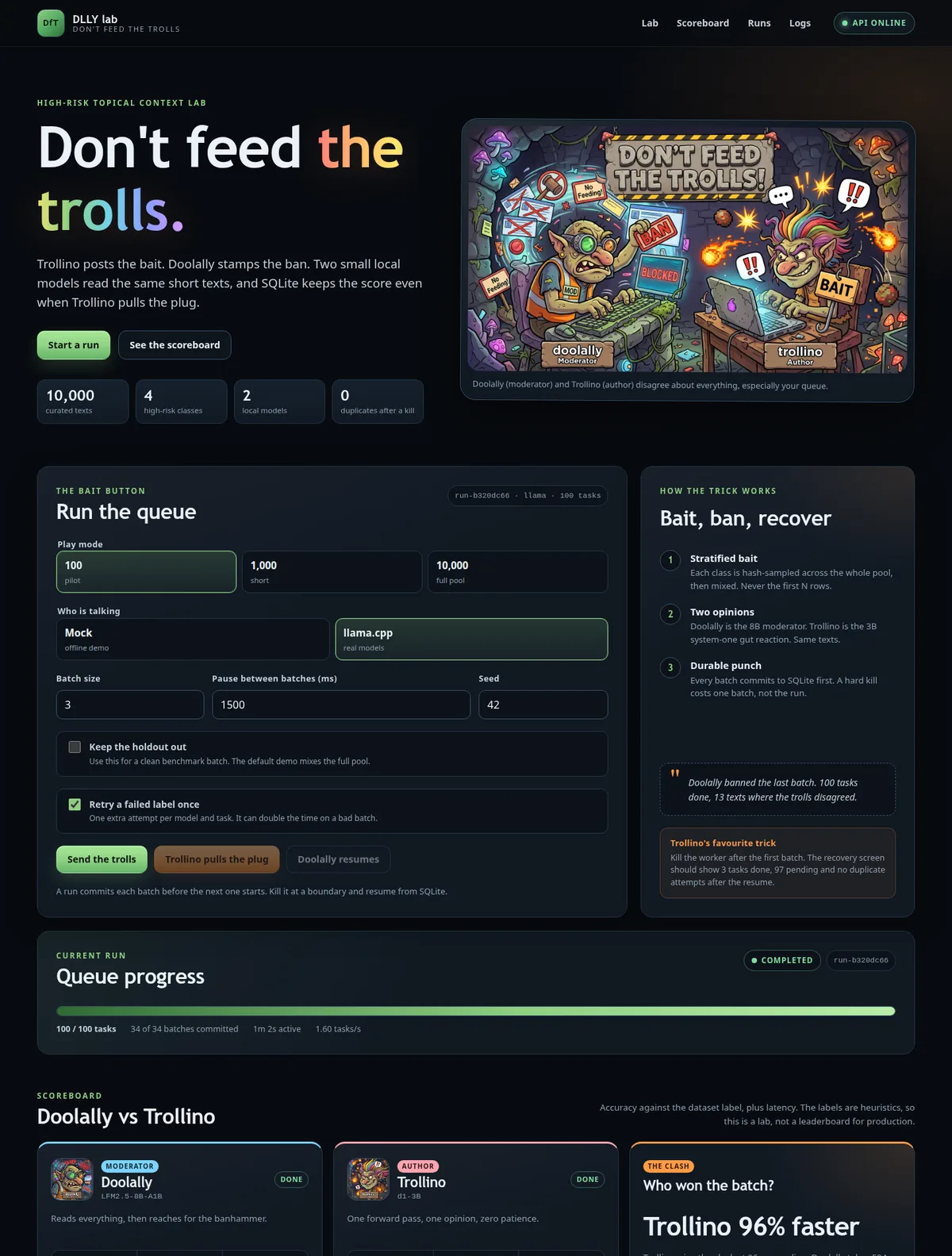
Trollino posts the bait. Doolally stamps the ban. Two small local models read the same short texts, and SQLite keeps the score even when Trollino pulls the plug.
This is an educational lab about the real cost of AI infrastructure: accuracy, latency, memory and recovery. It is not a production moderation system.

The characters are the mental model. The models are the actual comparison.
The 8B LFM model. Reads every word, thinks briefly, then picks a label. Slower, but careful. In the real run it landed within five points of the small model.

The 3B d1 decision model. One forward pass, no generated tokens, no second thoughts. In the real run it matched the 8B accuracy at about 22x the speed.
Bait, ban, commit, recover. The order matters.
Each class is hash-sampled across the whole pool, then mixed. Never the first N rows.
Both models get the same short text. Labels, confidence and latency are recorded.
An invalid label gets one more attempt. A bad batch can take twice as long, and that is visible.
Each batch commits to SQLite before the next starts. A hard kill costs one batch, not the run.
Plain HTML, CSS and JS. No framework, no build server, no data leaves the machine.
The local app runs at http://127.0.0.1:3030.
Mode 100, seed 42, same play sample, retry 1, zero provider errors.
| Model | Role | Accuracy | Median latency | Speed | Notes |
|---|---|---|---|---|---|
| LFM2.5-8B-A1BQ4_K_M, 5.16 GB | Doolally, moderator | 80-85% | 594 ms | 1x | Reasoning capped at 128 tokens |
| d1-3BQ4_K_M, 1.67 GB | Trollino, author | 85% | 26 ms | 22x faster | Decision model, one forward pass |
| LFM2.5-8B-A1B FTQ4KXL, 6.17 GB, optional | Speed variant | 65% | 110 ms | 5x faster | Not better here, so not the default |
Accuracy is measured against the dataset label. The labels are heuristic, so treat this as a lab result, not a leaderboard. LFM scored 85% in a host run and 80% in the container run, which is why the table shows a range. The optional fine-tune was tested because it follows instructions more directly. It was faster, but 15 to 20 points less accurate on this sample, so stock LFM stays the default.
The demo kill is a real SIGKILL at a batch boundary. The recovery is a real SQLite resume.
Short texts, four classes, a committed pool and an honest note about licenses.
10,000 rows, 2,500 per class. Eight experiment folds of 1,000 rows plus a 2,000-row holdout. Text is capped at 2,000 characters.
The rows are derived from user content and news. Review the terms before commercial use. The lab keeps source links and license metadata with the dataset.
Node 24, pixi and Docker with the NVIDIA runtime. All containers use the dlly- prefix.
pixi run python lab/models/download.py
docker compose -f docker/compose.yaml up -d --build
npm run server
# open http://127.0.0.1:3030
The mock provider runs without Docker and without models, so the full queue, kill and
resume flow can be demonstrated offline first. Phoenix at
http://127.0.0.1:6006 shows one span per committed batch.